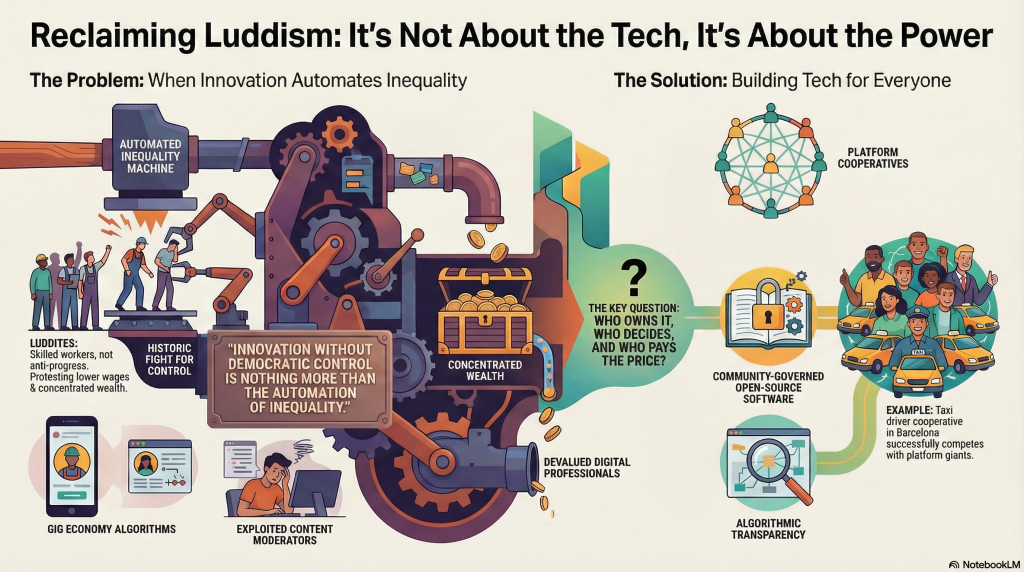
Reading Brian Merchant's Blood in the Machine while working at Innovation Campus creates a necessary dissonance. The term "Luddite" has become a lazy insult: we use it to label anyone who shows resistance toward the latest technological trend. But Merchant's essay flips this perspective on its head. Luddism was never a war against progress. It was a war for the control of progress.
A Problem of Power, Not Gears
The Luddites of the early 19th century were highly skilled workers. They knew their looms, they loved them, and they drew both their livelihood and their dignity from them. Their revolt was not aimed at the mechanics, but at how those mechanics were being used: as a tool to dismantle rights, lower production quality, and concentrate wealth in the hands of a few factory owners.
Merchant is clear on this point: the Luddites understood automation better than anyone else. They understood that technology is never neutral. When the introduction of a machine serves to justify starvation wages and destroy the social fabric of a community, that machine becomes a political weapon.
Technocracy and "Inevitable Progress"
In 2026, the narrative hasn't changed. We are repeatedly told that the advent of Artificial Intelligence and digital pervasiveness are inevitable processes—forces of nature to which we must simply adapt. Anyone raising doubts is dismissed as a dinosaur. But let's look at the hard facts:
This is contemporary Luddism: not rejecting technology, but asking who controls its use and under what conditions.
Rethinking Innovation in a Coworking Space
Discussing these themes within a coworking space like Innovation Campus is not a contradiction; it is a duty. Innovation stripped of ethical and social reflection becomes exactly that "god of profit" that English workers fought two centuries ago. Malaga is becoming a global tech hub, but technology without community is just cold efficiency.
What does it mean to innovate differently in practice? It means betting on:
These are not utopias. In Barcelona, taxi drivers created a digital cooperative to compete with Uber; in Europe, the Digital Services Act is beginning to mandate that platforms explain how their recommendation systems work. These are concrete strategies to prevent technology from merely amplifying existing inequalities. If power is distributed, technology can distribute opportunity.
Luddism as Clarity
Merchant's book is not an anti-computer manifesto. It is a warning against blind obedience to a technocratic system that tramples people and traditions in the name of a growth that doesn't belong to everyone.
Innovation without democratic control is nothing more than the automation of inequality. If we work in this sector, the question is not "can we build it?" but "who owns it, who decides, and who pays the price?". The Luddites didn't lose because they were against progress; they lost because they didn't have enough power to shape it.
We still have the room to choose: do we want to be the gears of a system or the architects of a progress that leaves no one behind?